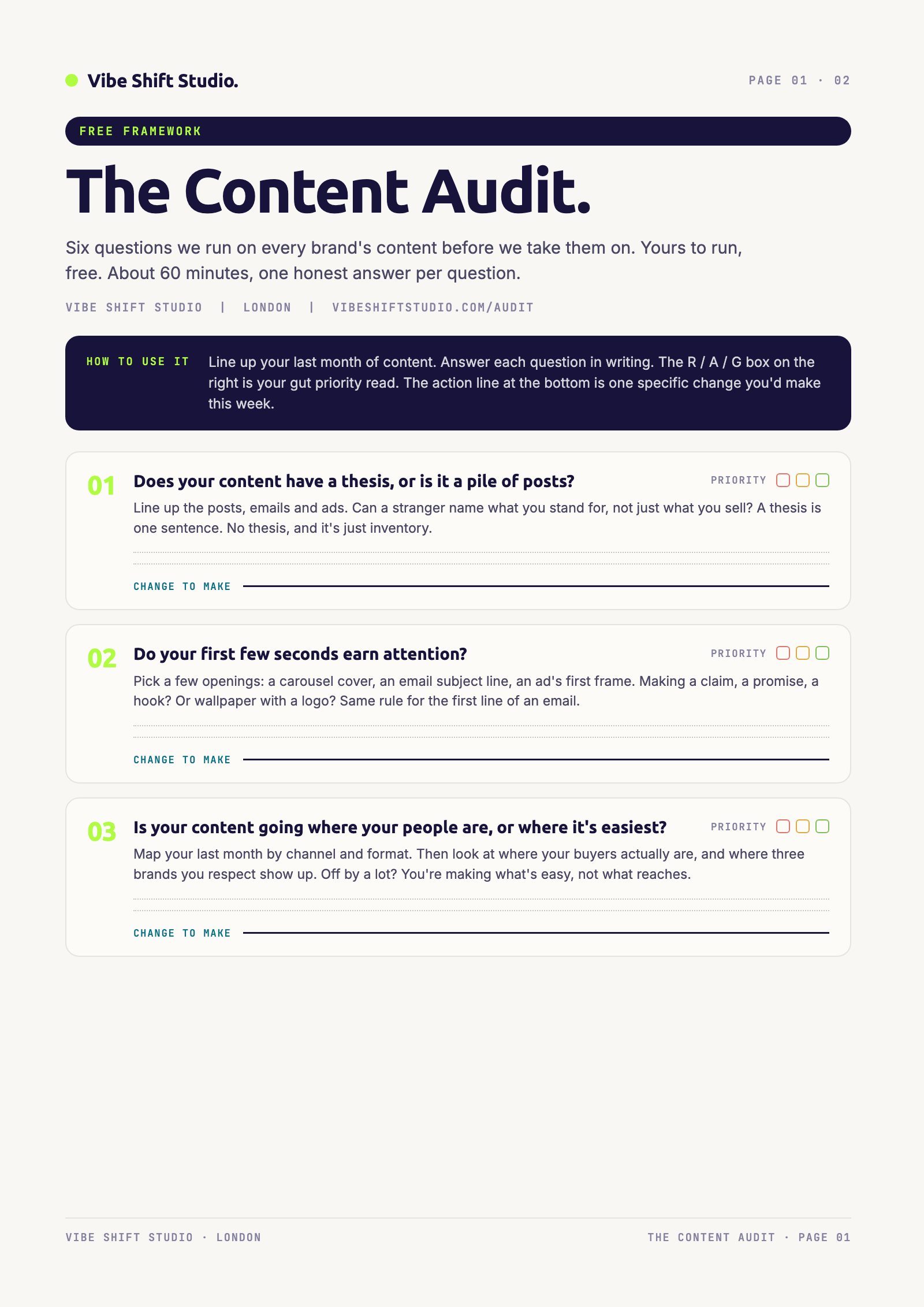
Every time a brand lands in the studio's inbox asking for help with content, we run their brand through the same set of questions before we say yes. It usually takes 45 minutes. By the end of it we know whether the work needs new content, new strategy, or a new direction.
You can run the same questions on your own brand. Most people don't. Below is the framework.
01. Does your content have a thesis, or is it a pile of posts?
Line up your last month of content: the posts, the emails, the ads. If a stranger had to describe what your brand stands for using only what they see, could they? If the answer is "they could probably guess we sell shoes," you don't have a thesis. You have inventory.
A thesis is one short sentence that explains why the brand exists. Every piece of content should be a reading of that sentence in a different format. If it all reads as "a series of posts our agency made this month," the audit ends here. Everything else is downstream.
02. Do your first few seconds earn attention?
Pick your last few openings: a carousel cover, an email subject line, the first frame of an ad. Read them out loud. Are they making a claim, a promise, or a hook? Or are they wallpaper with a logo?
The opening is doing all the work. If it doesn't survive the thumbprint test (would someone stop because of this single frame or line, before they know who you are), the content never had a chance.
Same rule applies to the first two seconds of a video and the first line of an email.
03. Is your content going where your people are, or where it's easiest to make?
Map your last month of output: which channels, which formats. Then look at where your customers actually spend their attention, and where three brands you respect in your category show up.
If you're pouring everything into the one channel you know while your buyers are somewhere else, you're making what's easy, not what reaches. This is the single biggest hidden problem we see.
04. Is your copy doing work, or is it decoration?
Take your last five pieces of copy: captions, an email, an ad. For each, ask: did this add a reason to act, save, or share? Or did it just restate what the image already said?
Copy that restates the visual is dead weight. The content would perform identically without it. Copy's job is to make the piece finish a different way than it started: a punchline, an ask, a stat, a question, a contradiction. If it's not doing that, cut it and replace with a single sharp line.
05. How often are you asking for something, and can people act on it easily?
Count the pieces in your last 30 that include a clear ask: "save this," "reply," "book a call," "tap the link." If less than 1 in 10 does, you're educating without converting. If more than 1 in 5 does, you're converting without earning the trust.
The ratio that works for most brands is about 1 in 8. Earned, then asked.
06. What's the competitive whitespace, and are you in it?
Make a list of the five brands you compete with most directly. Open their content side by side: feeds, emails, ads. What are all of them doing? What is none of them doing? The "none of them doing" column is your whitespace.
If your brand is doing exactly what your five competitors are doing, you're not differentiated. You're inventory in the same shape. The audit's last question is the most uncomfortable, because the answer is usually: pick a corner of the whitespace and commit to it.
The result of the audit.
If you answer the six questions honestly, one of three things will become clear:
- You need better content (questions 2, 3, 4)
- You need better strategy (questions 1, 5)
- You need a different direction altogether (question 6)
Most brands need a mix of one and two. Few need three.